Ivanov’s Ape Experiment: The Quest to Create a Human-Ape Hybrid
The Savage Souls of Dr. Zobakov is a work of fiction—but the astonishing scientific experiments that inspired Dr. Zobakov, including Soviet biologist Ilya Ivanov's controversial attempts to create human-ape hybrids, were all too real. Stranger than fiction, these forgotten experiments remain among the most bizarre chapters in modern science. Here's where the facts end and the fiction begins.
The Quest to Create a Human-Ape Hybrid
Long before science fiction filled laboratories with mad scientists and impossible creatures, one respected biologist believed he could answer one of humanity's oldest questions—not through philosophy or religion, but through biology. Could humans and great apes produce hybrid offspring?
The idea sounds like the premise of a pulp adventure, yet during the 1920s it became the life's work of Soviet scientist Ilya Ivanovich Ivanov, one of the world's foremost authorities on artificial insemination. His experiments, carried out with the support of the Soviet government, sought to test evolutionary theory in the most controversial way imaginable: by attempting to cross humans and chimpanzees.
Though the experiments ultimately failed, they became one of the strangest—and most unsettling—episodes in the history of modern science.
A Pioneer of Artificial Insemination
Born in 1870, Ivanov was no fringe researcher. By the early twentieth century, he was internationally respected for developing artificial insemination techniques that transformed livestock breeding. Horses, cattle, sheep, and other domesticated animals could be selectively bred on an unprecedented scale using methods he helped pioneer.
His success led him to believe that artificial insemination might also overcome reproductive barriers between closely related species. Ivanov successfully produced hybrids among several species of horses and zebras, strengthening his confidence that similar techniques could answer questions about the evolutionary relationship between humans and the great apes.
At the time, Darwin's theory of evolution remained politically and culturally contentious. Ivanov believed that producing a human-ape hybrid would provide dramatic evidence of humanity's evolutionary origins.
The African Expeditions
In 1926, Ivanov traveled to French Guinea (modern Guinea), home to one of the world's richest populations of chimpanzees. Working at the Institut Pasteur's field station near Kindia, he established a temporary research facility where captive chimpanzees could be studied.
His first plan was shocking even by the standards of the era. Female chimpanzees were artificially inseminated with donated human sperm in hopes of producing hybrid offspring. None of the animals became pregnant.
Undeterred, Ivanov proposed an even more controversial second phase. Upon returning to the Soviet Union, he sought volunteers willing to be artificially inseminated with ape sperm. Historical records suggest that several women expressed interest in participating, though the experiments never proceeded. Before the project could begin, the only surviving male orangutan available for the work died, bringing the research to an abrupt halt.
Whether any pregnancies might ever have occurred remains unknown. None were ever documented.
Science, Ethics, and Politics
Modern genetics tells us that humans and chimpanzees share approximately 98–99% of their DNA, making them our closest living relatives. Yet that small percentage masks profound biological differences. Humans possess 46 chromosomes, while chimpanzees have 48, reflecting millions of years of independent evolution. Even if fertilization were theoretically possible, developmental barriers would almost certainly prevent the production of a viable hybrid.
Such knowledge was unavailable to Ivanov. In the 1920s, chromosomes had only recently been recognized as carriers of heredity, and DNA itself would not be identified as the molecule of inheritance for another quarter century.
Today, experiments of this kind would be considered profoundly unethical. They violated principles of informed consent, animal welfare, and human research ethics that now form the foundation of modern biomedical science. Yet Ivanov's work emerged during an era when scientific ambition often outpaced ethical oversight, particularly within governments eager to demonstrate technological progress.
The Fall of Ivanov
Ivanov's scientific reputation gradually declined as his increasingly ambitious hybridization projects failed to produce meaningful results. Political changes within the Soviet Union further complicated his career. In 1930, he was arrested during Stalin's political purges, accused of counter-revolutionary activities, and exiled to Kazakhstan.
He died two years later, in 1932, never achieving the scientific breakthrough that had consumed his later career.
His experiments faded into obscurity, surviving largely as curious footnotes in the history of biology until renewed public interest decades later.
Legacy in Modern Imagination
Ivanov never created an ape-man.
But the idea proved remarkably durable.
Stories of secret laboratories, missing research subjects, and forgotten jungle experiments became staples of pulp fiction throughout the twentieth century. Whether in the pages of Edgar Rice Burroughs, classic horror films, or later adventure novels, the notion of a scientist pushing evolution beyond its natural limits captured the public imagination.
In The Savage Souls of Dr. Zobakov, that unsettling chapter of scientific history becomes the foundation for fiction. Dr. Dimitry Zobakov is not Ilya Ivanov, and the events of the novel never occurred. Yet the setting—a remote research station in French Guinea, the lingering echoes of Soviet biological research, and the tantalizing question of what might happen if one scientist refused to abandon impossible experiments—draw directly from one of the most extraordinary episodes in twentieth-century science.
Like many of the Riley Chase adventures, the novel begins with history. Only then does it step into the shadows.
~ E.M. Quest
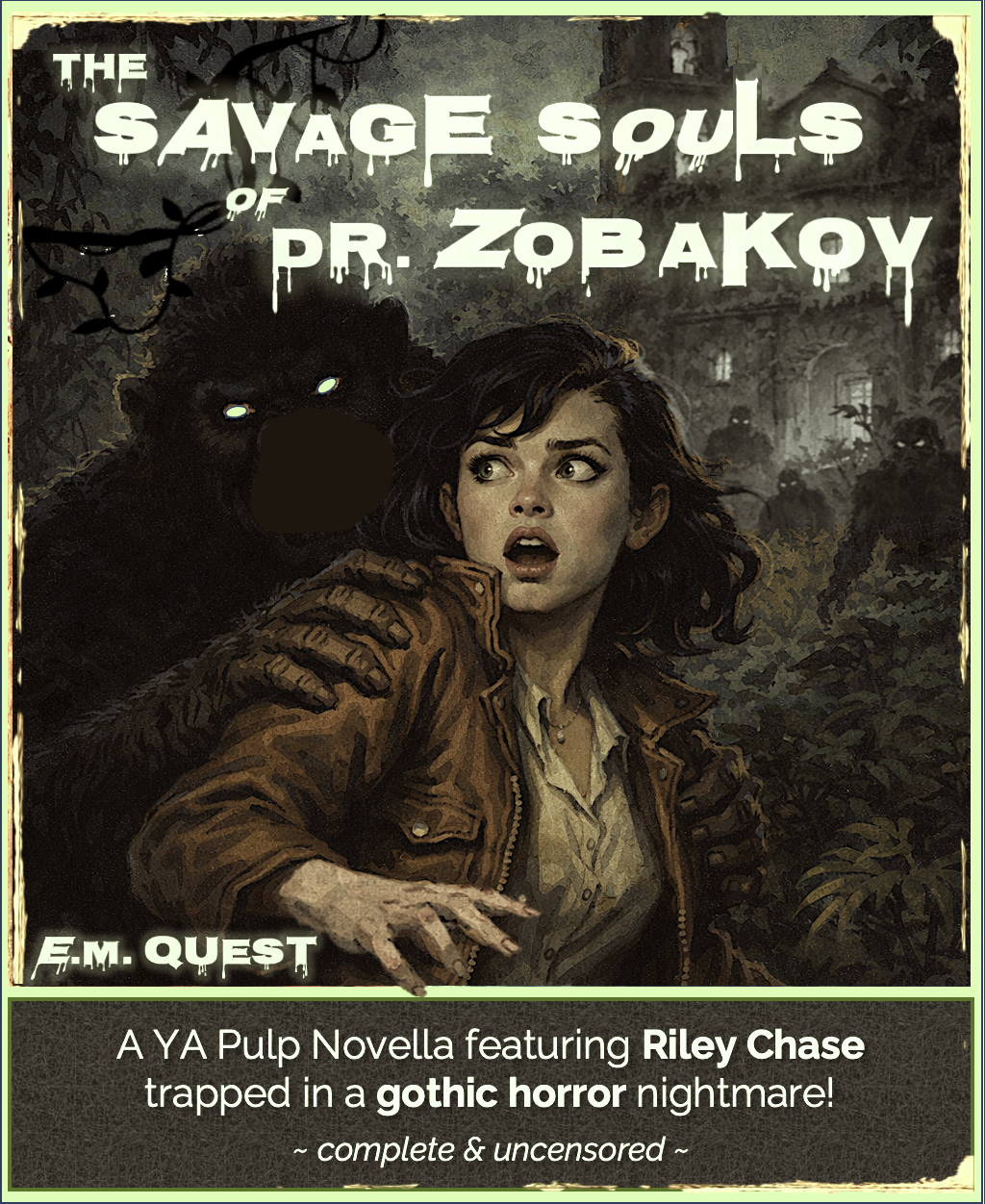
Featured in: The Savage Souls of Dr. Zobakov
You might also enjoy reading about: