The Real History of Franz Josef Land
Frozen by the Astronomer of Terror is a work of fiction—but Franz Josef Land, the daring explorers who charted its frozen shores, and many of the hardships Riley endures are drawn from real history. Long before she ventured into the High Arctic, brave explorers risked everything to reach one of the most remote places on Earth. Here's where the facts end and the fiction begins.
Frozen Frontiers
There is a silence in the high Arctic that goes deeper than mere quiet. It is a silence of ice, of stillness, of white horizons broken only by the moaning of wind and the groan of shifting glaciers. That silence swallows time. And in the archipelago of Franz Josef Land, at the edge of the known world, explorers once chased secrets into that silence—some never returned.
In Frozen by the Astronomer of Terror, Riley follows the long-frozen footsteps of Benjamin Leigh Smith, a real 19th-century Arctic explorer who ventured to this remote and perilous region in search of knowledge—and perhaps left behind more than anyone ever realized.
Franz Josef Land:
Edge of the Map
Lying deep within the Barents Sea, north of Novaya Zemlya and just shy of the North Pole, Franz Josef Land is an archipelago of more than 190 glaciated islands. Icebound most of the year, the islands are inhospitable, haunted by polar bears, swirling mists, and months of unbroken darkness. For centuries, they were unknown to Europeans, unmarked on maps—until the late 1800s, when the heroic age of polar exploration came to their jagged shores.
Discovered (at least in European records) by an Austro-Hungarian expedition in 1873, the islands were named after Emperor Franz Joseph I. But over the next decades, they would be claimed, charted, and sometimes marooned upon by explorers from Britain, Norway, America, and Russia—each seeking glory, science, or the elusive sea route over the top of the world.
Benjamin Leigh Smith:
The Gentleman Explorer
Among those who braved this frozen wilderness was Benjamin Leigh Smith, a wealthy British gentleman who eschewed military pomp in favor of quiet, scientific exploration. Educated at Cambridge and trained in law, Leigh Smith was an unlikely Arctic hero. Yet between 1871 and 1882, he launched five private Arctic expeditions—often at his own expense.
In 1880 and 1881, Leigh Smith’s ship, the Eira, carried him to Franz Josef Land, where he charted new coasts, studied glacial formations, and mapped the mysterious terrain of the islands. He made landfall on several points in the archipelago—including Bell Island, where he is known to have constructed a wooden cabin that served as a base and shelter.
That cabin still exists. Though battered by time and the elements, it stands as one of the oldest man-made structures in the high Arctic. Today, researchers and tourists who reach Bell Island sometimes visit the site, marked by the desolate remains of Leigh Smith’s outpost, eerily preserved in the permafrost.
For Riley Chase, this cabin becomes a beacon—a tether to the past and a source of mystery. But in truth, it is already haunted: by history, hardship, and the specter of those who vanished in the white.
Survival in the Ice
Leigh Smith’s expeditions were known for their relative success and minimal loss of life—a rarity in an era when Arctic exploration was as much a gamble as a science. But that doesn’t mean he was untouched by disaster. In 1881, the Eira was crushed by ice off Cape Flora, forcing Leigh Smith and his men to survive ten months in the Arctic with only salvaged supplies and that rough-hewn hut. He did not panic. He did not boast. He simply endured.
The British Navy finally rescued the party in August 1882, and Leigh Smith never returned to the Arctic. But his detailed reports, maps, and photographs (some of the earliest Arctic images on record) became vital to future explorers—and the eerie cabin he left behind endures, a solitary relic of human stubbornness in the face of nature’s indifference.
Tikhaya Bay and the Soviet Shadow
In Riley’s time, Tikhaya Bay is the point of radio contact—the last fraying thread to the outside world. Located on Hooker Island, this bay became the site of a Soviet-era polar research station established in the 1920s and active for decades. By the 1930s, the Soviet Union had taken control of Franz Josef Land, maintaining meteorological stations and scientific outposts—even through World War II and the Cold War.
Tikhaya Bay’s station was eventually abandoned, but many of its buildings remain intact, filled with dusty journals, rusted machinery, and the sense that someone might still be watching through a frost-fogged window. It is not hard to imagine ghosts lingering there—not spirits, perhaps, but the echo of intentions, secrets, and silence.
Artifacts, Myths, and the Lure of the Unknown
Frozen by the Astronomer of Terror blends history with horror, but the setting is more real than fictional. Franz Josef Land has always inspired strange stories: of sky-piercing auroras, mysterious artifacts trapped in ice, and explorers driven mad by the polar night. Some whispered of ancient technologies buried beneath the glaciers, or ships seen drifting with no crew. In a place where compasses spin and time seems to warp, it is no surprise that myth and memory blur.
For Riley Chase, the past is not just prologue—it is a trap, an enigma, and a source of terror. She walks where Leigh Smith once walked. She sees what he may have seen. But what she finds in that distant land goes beyond the historical record.
History, after all, has gaps. And Franz Josef Land is full of them.
~E.M. Quest
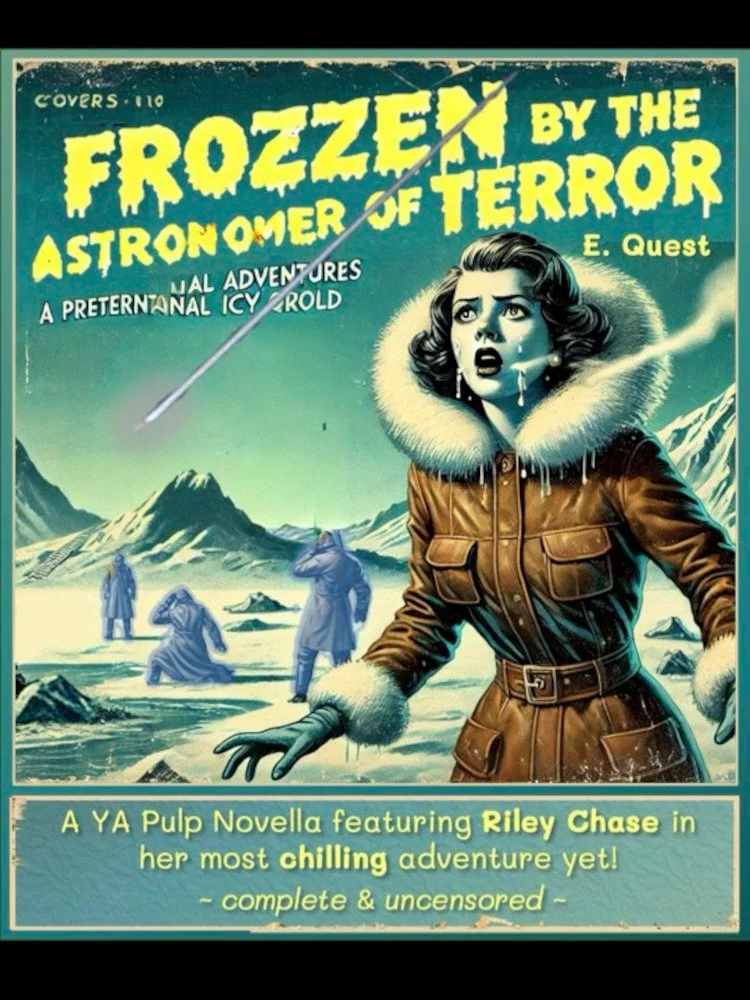
Featured in: Frozen by the Astronomer of Terror
You might also enjoy reading about: