Paranormal Truths and Fictional Shadows
The Secret of Ravenskar Castle is a work of fiction—but the psychical researchers, ghost investigations, and scientific curiosity that inspired Riley's adventure were all very real. During the late nineteenth and early twentieth centuries, some of the world's leading scholars seriously investigated claims of the supernatural. Here's where the facts end and the fiction begins.
The World of Early 20th Century Psychical Research
By the early 20th century, the Western world stood at a curious crossroads between reason and revelation. The microscope and the séance table shared uneasy space in drawing rooms across England and America. Scientists calibrated instruments while mediums communed with the dead. It was an age of shadows and science, of war and mourning, of belief and doubt. And into that liminal space stepped a peculiar kind of investigator: the psychical researcher.
Alistair, in The Secret of Ravenskar Castle, names two such figures—Harry Price and J.B. Rhine—whose work straddled the line between legitimate inquiry and the unknowable beyond. These men, along with others like them, formed the vanguard of a movement that tried to peer beyond the veil using tools of reason and observation. Their world—both factual and fictional—informs the eerie landscape of Ravenskar Castle, where spirits might walk, and secrets breathe behind the walls.
A Brief History of Spiritualism
Spiritualism, the belief that the dead could communicate with the living, rose to prominence in the mid-19th century, exploding in popularity after the Fox Sisters of New York claimed to contact a spirit through mysterious knockings in 1848. By the early 1900s, spiritualism had evolved into a global movement, with séances, table-tipping, automatic writing, and ectoplasmic manifestations becoming part of the popular culture.
Though often dismissed as mere fad or superstition, spiritualism found fertile ground in a society fractured by grief. The First World War devastated families across Europe, and the Spanish flu pandemic shortly after took millions more. In that atmosphere, the idea that loved ones might linger beyond the grave—and could still speak—offered comfort. Even notable intellectuals, like Sir Arthur Conan Doyle, became outspoken defenders of spiritualism, with Doyle penning several books on the subject following the loss of his son.
The Rise of Psychical Research
While mediums and mystics filled the parlors, others took a more methodical approach. The Society for Psychical Research (SPR) was founded in London in 1882, with the goal of applying scientific rigor to the study of the supernatural. The SPR aimed to investigate claims of ghosts, telepathy, apparitions, and survival after death, using observation, interviews, photography, and statistical analysis.
Among its members were figures like Frederic Myers, Eleanor Sidgwick, and William Barrett—serious scholars who treated reports of hauntings and visions not as tabloid fodder but as potential data. While many investigations ended in fraud or inconclusiveness, some cases proved genuinely puzzling.
Harry Price and the Haunted Laboratory
Enter Harry Price, one of the most flamboyant and recognizable figures in psychical research. A magician, writer, and ghost-hunter, Price is perhaps best remembered for his investigations into the Borley Rectory, widely dubbed “the most haunted house in England.” In the 1930s, he outfitted the rectory with recording devices, trigger cameras, and detailed logs to track unexplained phenomena. While skeptics eventually challenged much of his evidence, Price’s work set the template for modern paranormal investigation—part showman, part scientist.
He also founded the National Laboratory of Psychical Research in London, where he attempted to test mediums under controlled conditions. His equipment included spirit trumpets, thermographs, infrared cameras, and electromagnetic field detectors—devices that wouldn’t seem out of place in a modern ghost-hunting show.
For readers of Ravenskar, Price’s methodology echoes in Alistair’s cautious, reasoned attempts to document the castle’s phenomena without dismissing them outright.
J.B. Rhine and the Birth of Parapsychology
While Price stalked British ruins, American botanist-turned-parapsychologist Joseph Banks Rhine pioneered the statistical study of extrasensory perception (ESP) at Duke University in North Carolina. Rhine introduced Zener cards (those familiar symbols: circle, square, waves, star, cross) to test for clairvoyance and telepathy, aiming to quantify “psi” ability under laboratory conditions.
His work—both lauded and criticized—marked the shift from Victorian mysticism to a more clinical form of inquiry, one that tried to position paranormal research within academic psychology. Rhine coined the term parapsychology and founded the Journal of Parapsychology in 1937, helping institutionalize the field.
Though his methods were more mathematical than mystical, Rhine’s belief in the existence of a real, measurable psychic force would have found sympathetic ears in the shadowy halls of Ravenskar.
Fictional Ghost-Hunters:
Carnacki and the Rational Occult
Overlaying these historical threads are the fictional detectives who dared to face the unknown with candle, chalk circle, and revolver. Chief among them is Carnacki the Ghost-Finder, the creation of British author William Hope Hodgson. First appearing in 1910, Carnacki combined occult knowledge with emerging technology, using electric pentacles, photographic plates, and arcane rites to investigate hauntings that were sometimes supernatural, sometimes hoaxes.
Carnacki was no charlatan: he approached each case with skepticism and thorough preparation, reflecting the same spirit as the SPR and Price. And like Alistair and Riley, he did not assume that every ghost was truly a ghost—or that every fraud was harmless.
Carnacki’s stories, along with later tales like Algernon Blackwood’s Dr. John Silence or M.R. James’s unnervingly clinical ghosts, helped define the weird tale—that perfect marriage of intellect and unease, where the line between science and superstition was constantly shifting.
A Haunted World Between Wars
By the 1930s, spiritualism and psychical research coexisted awkwardly. The former remained popular among the grieving and curious; the latter increasingly isolated within academic and skeptical circles. Still, both retained cultural power. The interwar years were a time of seances and specters, of rational men dabbling in irrational spaces. Radios buzzed with strange voices. Photographs bore translucent shapes. Castles and cottages alike whispered of footsteps, cold spots, and unquiet souls.
It is in this liminal world that The Secret of Ravenskar Castle is set. A world where a young man like Alistair might cite Rhine or Price with earnest conviction, even as the wind howls through ruined battlements and secrets stir beneath ancestral stone.
~E.M. Quest
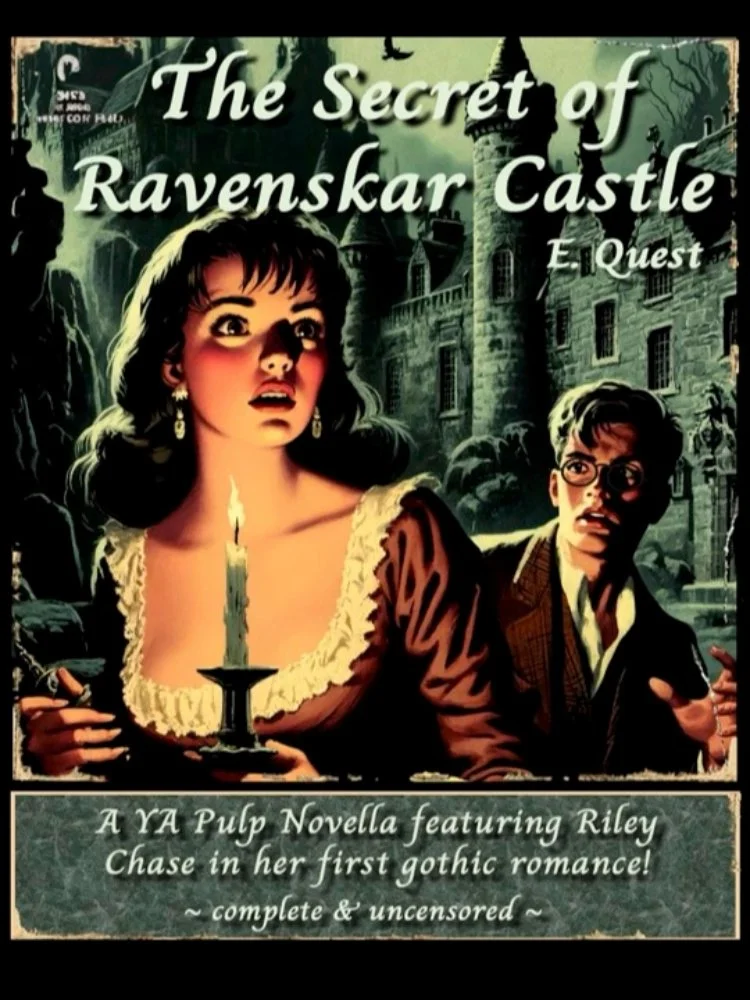
Featured in: The Secret of Ravenskar Castle
You might also enjoy reading about: